
Crystal Compass
Malachite Identification: Natural Patterns, Imitations & Care
Malachite identification starts with its green mineral texture, not a rule that “black bands mean fake.” Natural malachite can be very dark green, and a convincing banded surface can also be imitated. Use several observations and a clear seller disclosure together; a photograph cannot certify a bead or carving.
Updated October 19, 2026. A source-based guide, not a laboratory identification or a report on a specimen tested by Crystal Compass.
Visual checks · Look-alikes · Care · Buying checklist
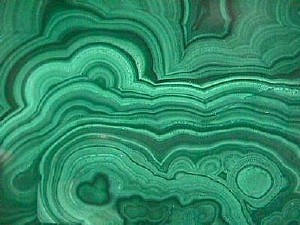

What malachite is
Malachite is a copper carbonate hydroxide mineral, Cu₂CO₃(OH)₂. The Mineralogical Society of America’s Handbook of Mineralogy records hardness 3.5–4, green through blackish-green colors, and forms including rounded aggregates and radiating fibrous growth. A polished surface can look quite different from the original rough specimen.
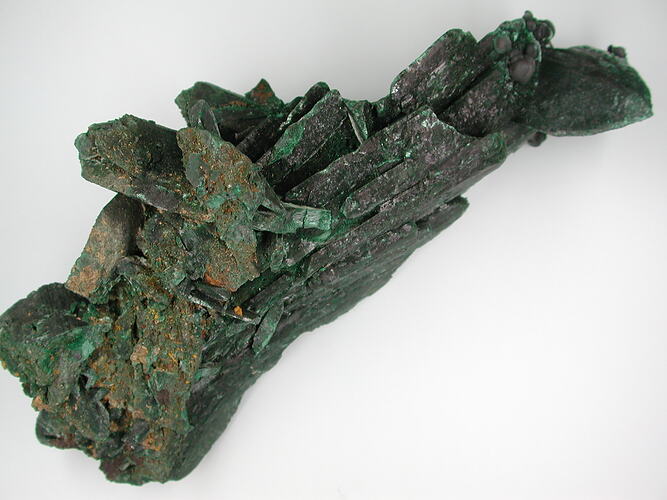
A non-destructive inspection you can actually use
- Separate rough material from a manufactured object. A mineral cluster, a carved animal and a round bead do not preserve the same evidence. Photograph the whole object and any existing unpolished areas.
- Follow a band around the surface. On a polished item, see how the pattern continues around curves and drill holes. Note repeated motifs, seams or a coating that appears to stop at an edge. These are reasons to ask questions, not automatic proof of an imitation.
- Use neutral light and several views. A very dark band may appear black in a photograph. Look at it from another angle before applying a color rule. Avoid filters and extreme exposure changes.
- Compare several beads, not just one. Near-identical printed-looking patterns across an entire strand deserve closer inspection. Natural materials vary, but skilled imitations can vary too.
- Stop before destructive testing. Do not scratch a hidden patch, use acid, heat the object or grind powder. For a meaningful purchase, independent material identification is more useful than damaging the item.
Natural, reconstituted and imitation are different claims
Plastic or resin imitations
Mold seams, repeated decoration or unexpectedly light construction can be warning signs. None is a universal test: size, hollow construction and settings change the way an item feels. Do not use a hot needle or solvent to investigate it.
Glass and other green stones
A green color alone does not establish malachite. A seller should identify the material, not just supply a color name. Glass may contain bubbles, but the absence of visible bubbles does not prove a natural mineral. If the surface is uniformly green with no useful texture, a photo may be insufficient.
Reconstituted or composite material
Ask whether particles have been bonded into a new object, whether a coating or backing is present, and whether the sale describes the whole item or only a surface layer. “Contains malachite” is not the same claim as “carved from one natural piece.” Transparent disclosure matters more than assigning every processed object the same “fake” label.
Natural malachite with other minerals
Mixed colors can reflect an associated mineral rather than an imitation. The Handbook lists associations including azurite and chrysocolla. Do not assume every part of a mixed specimen has identical properties or cleaning needs.
Care: protect the finish and avoid invasive tests
Because malachite is much softer than quartz, our conservative recommendation is separate storage and minimal handling of fragile rough surfaces. Use a clean soft cloth gently on a sound polished object. Avoid acids, abrasive cleaning, steam and prolonged soaking; follow the maker’s guidance for coatings, glue and metal settings.
- Jewelry: remove it for cleaning, swimming or activities that knock the surface. Keep it from rubbing against harder stones.
- Rough or powdery specimens: keep them contained and do not brush aggressively or cut/grind them at home.
- Displays: use a stable support and lift the specimen rather than dragging it across a shelf.
- Unknown treatment: ask the supplier before trying to remove a stain. Do not put mineral specimens into drinking water.
For contact and storage questions, see crystal combinations that need extra care and malachite with rose quartz.
Four questions to ask before buying
- Is the item solid natural malachite, a composite, a treated material or an imitation?
- Are the images of the actual piece, including the reverse and edges?
- What supports any claimed locality or treatment history?
- What return or independent-testing arrangement applies if the material is disputed?
Common questions
Does black-looking banding mean fake malachite?
No. Very dark green occurs naturally, and lighting can deepen its appearance. Evaluate texture and disclosure together; do not use one color as a verdict.
Can weight prove it is real?
No. A weight comparison is meaningful only when volume and construction are controlled. A small stone, a hollow object and a metal-mounted piece cannot be judged by heft alone.
What does malachite mean?
You may choose it as a personal symbol of change or growth. That is a personal interpretation, not evidence of healing or a promise of luck.
Next: compare other crystal features · browse the crystal library · learn non-destructive identification.