Garnet
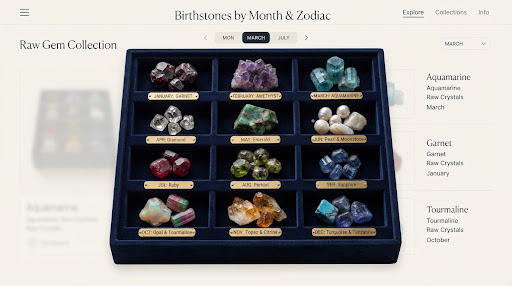
Deep Pyrope and Almandine silicate group. Documented across ancient Mediterranean trade routes and European lore.
Birthstone traditions vary across cultures, eras, and published lists. Discover the historical origins, geological identities, and traditional symbolism of your birth gem.
One widely used modern U.S. list was standardized in 1912 and later expanded; lists still vary across regions, traditions, and historical authorities.
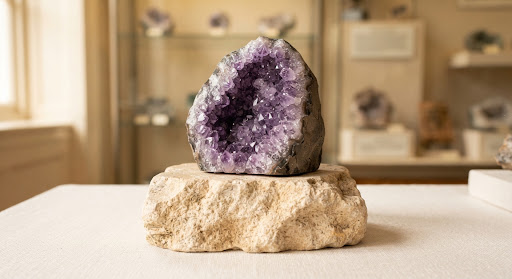
Both traditional and modern lists celebrate violet quartz as the gemstone for February. Celebrated in antiquity for clarity and composure, amethyst combines enduring durability (Mohs 7) with rich natural iron irradiation color centers.
Standardized mineral classifications cross-referenced with Mohs hardness metrics and classical archival significance.
Deep Pyrope and Almandine silicate group. Documented across ancient Mediterranean trade routes and European lore.
Violet macrocrystalline quartz. Recorded since classical Hellenistic antiquity in lapidaries and historical ornaments.
Luminous iron-bearing blue beryl variety. Historically associated in maritime folklore with sea voyages and safe passage.
Elemental carbon organized in an isometric crystal lattice, recognized historically for exceptional hardness and dispersion.
Chromium- and vanadium-colored green beryl containing characteristic mineral inclusions (jardin).
Biogenic calcium carbonate (pearl), adularescent feldspar (moonstone), and color-shifting chrysoberyl (alexandrite).
Chromium-bearing red corundum. Historically chronicled in ancient Sanskrit and European lapidary texts as a premier jewel.
Idiochromatic green olivine, isometric magnesium aluminium spinel, and banded chalcedony sardonyx.
Non-red varieties of corundum, characteristically deep blue through iron and titanium intervalence charge transfer.
Hydrated amorphous silica showing optical diffraction (play-of-color) alongside complex cyclosilicate tourmaline.
Aluminium fluorosilicate topaz and iron-bearing macrocrystalline quartz citrine in characteristic golden-amber tones.
Hydrated copper aluminium phosphate (turquoise), pleochroic zoisite (tanzanite), and zirconium silicate (zircon).
Astrological gemstone pairings are folklore traditions that evolved across medieval lapidaries and cultural mythologies. They are documented here solely as cultural history, not as empirical scientific facts or geological properties.
Bloodstone & Red Jasper
Courage, vitality, pioneering momentum
Rose Quartz & Emerald
Traditional symbolism: devotion and calm
Citrine & Agate
Mental agility, balance, joyful curiosity
Moonstone & Ruby
Nurturing intuition, safe shelter, deep loyalty
Peridot & Sunstone
Solar radiance, heartfelt warmth, leadership
Carnelian & Blue Sapphire
Discernment, quiet mastery, analytical focus
Lapis Lazuli & Opal
Harmonious justice, grace, artistic perspective
Malachite & Topaz
Metamorphic renewal, unyielding depth
Turquoise & Sodalite
Far-flung exploration, philosophical freedom
Garnet & Smoky Quartz
Patient endurance, structural architectonics
Amethyst & Labradorite
Visionary independence, collective insight
Aquamarine & Fluorite
Mystical empathy, fluid receptivity, dreams
The tradition of allocating minerals to specific points of the solar cycle did not originate in modern retail catalogs. Its roots trace back to the Book of Exodus (chapter 28), which describes the Hoshen, or ceremonial Breastplate of Aaron. Mounted in four tiers of gold filigree were twelve precious stones, each inscribed with the name of one of the twelve tribes of Israel: sardius, topaz, carbuncle, emerald, sapphire, diamond, ligure, agate, amethyst, beryl, onyx, and jasper.
By the first century CE, Jewish-Roman historian Flavius Josephus and Saint Jerome connected these twelve breastplate stones directly to the twelve signs of the Zodiac and the twelve calendar months. In early Christian and Mediterranean traditions, it was customary to own all twelve gems and wear each individually during its corresponding month, believing the stone possessed peak energetic affinity while the sun traversed that quadrant.
The modern custom of wearing a single stone matched exclusively to one's birth date emerged in eighteenth-century Poland, bolstered by gem merchants arriving from Nuremberg and Central Europe. In August 1912, the American National Association of Jewelers (now Jewelers of America) convened in Kansas City to standardize the list, harmonizing confusing regional folklore and introducing commercially accessible transparent varieties like tanzanite and spinel in subsequent mid-century revisions.
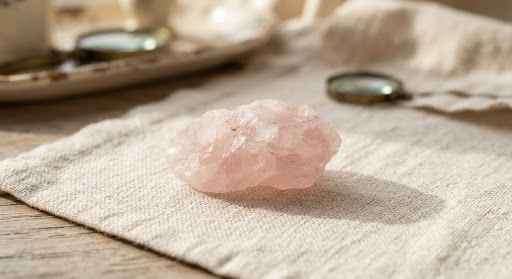
Unpacking the divergences between ancient 15th-century lapidary lists and the commercial 1912 Kansas City standards.
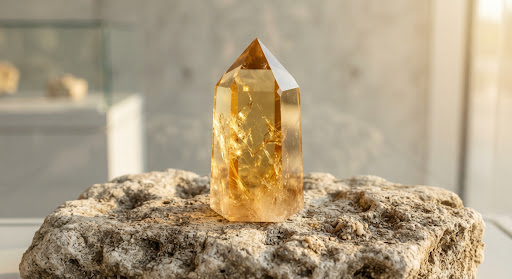
How transition metal trace elements like iron, chromium, and vanadium bestow signature hues to quartz and beryl.
Essential durability checkpoints, Mohs scale pairing cautions, and cleaning guidelines for everyday wearable talismans.
Mineral properties are presented separately from folklore associations. Source notes accompany published guides, and zodiac associations are included only as cultural traditions.