Amethyst: Identification, Meaning & Care
A macro-crystalline violet variety of quartz formed by natural radiation and trivalent iron within silica-rich cavities. Revered through centuries of traditional folklore and cherished as a durable, contemplative companion.
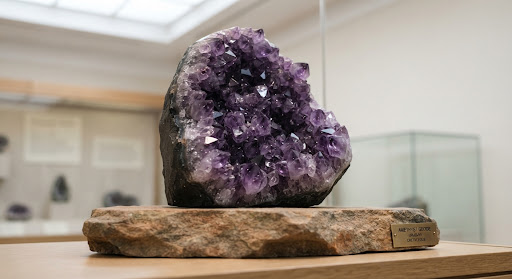
Raw Amethyst Geode Specimen #AM-8924 — Rio Grande do Sul, Brazil. Vitreous luster on basalt matrix.
Quick Facts: At-A-Glance
SiO₂
Silicon Dioxide (silica group tectosilicate)Crystalline Quartz
Macrocrystalline violet varietyVitreous
High glass-like reflection on crystal facesTransparent to Translucent
Allows light through gem-grade prismatic pointsRating 7.0
Mohs 7 offers good everyday scratch resistance, but amethyst can still chip and harder materials can scratch it.Lilac to Deep Violet
Frequently displays geometric color zoning and phantomsHow to recognize likely amethyst
A visual guide cannot prove natural origin, treatments, or authenticity; consult a qualified gemologist for valuable or safety-critical specimens. Mineral enthusiasts rely on non-destructive observational cues rather than physical abrasion.
Curatorial Diagnostic Notice
Visual checklists narrow candidate minerals without damaging specimens. However, synthetic quartz, lab-grown varieties, or thermal treatments cannot be ruled out visually and require certified gemological testing.
Mohs 7 is a reference property, not a test we recommend performing on an unknown or valuable stone.
Scratch testing can permanently fracture crystal terminations, reduce specimen value, and produce dangerous micro-shards. Instead, examine non-destructive physical features: natural crystal habit, vitreous luster, characteristic conchoidal chip patterns, and natural color zoning.
Crystal Geometry & Habit
Amethyst crystallizes in hexagonal prisms terminating in pyramidal 6-sided faces. Look for clusters nestled inside hollow basalt geodes, or single tapered columnar wands. It never grows in cubes or sheets.
Color Saturation & Geometric Zoning
Authentic earth-mined amethyst rarely displays completely uniform monotone purple. Submerged in water or back-lit against light, you will notice angular bands, triangular color concentrations, and pale smoky undertones.
Conchoidal Fracture (No True Cleavage)
When struck or chipped, amethyst breaks like thick bottle glass—forming curved, concentric ripples called conchoidal fractures. If your specimen flakes into geometric staircases or flat cubes, it is another mineral entirely.
Luster & Surface Light Reflection
Inspect the faces under ambient daylight: clean crystal facets show a glassy (vitreous) reflection without greasy, pearly, or resinous sheen. Note that Mohs 7 is a reference property, not a test to perform on your piece.
Purple Lookalike Comparison Vitrine
Distinguishing amethyst from other notable violet specimens through structural hardness, crystal habit, and cleavage planes.
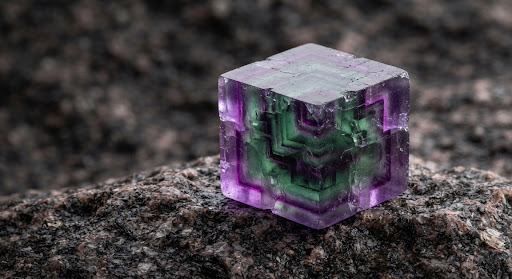
Purple Fluorite (CaF₂)
How to distinguish from Amethyst: Fluorite is significantly softer (Mohs 4) and easily scratches with a copper coin or common nail. Furthermore, fluorite cleaves in perfect octahedral steps, unlike the irregular conchoidal fractures of amethyst.
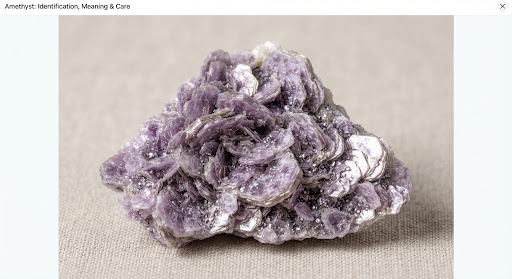
Lepidolite Mica
How to distinguish from Amethyst: Lepidolite is a soft, lithium-rich mica aggregate. It possesses a scaly, micaceous, or granular texture that can easily be scratched or peeled apart with a human fingernail. It never forms hexagonal quartz terminations.
Mineralogical Facts & Geochemistry
Geologically, amethyst derives its purple coloration not from broad chemical composition, but from trace trivalent iron (Fe³⁺) ions substituted within the crystal lattice, subjected to natural ionizing gamma radiation from host rocks over geologic epochs.
Traditional Meaning & Cultural Folklore
Etymology & Ancient Sobriety Lore
The name originates from classical Greek amethystos, translating literally to "not drunken." Ancient Hellenic folklore attributed the mineral with protective qualities against intoxicating wine, prompting craftsmen to carve ceremonial drinking chalices and amulets directly from rough violet crystalline masses.
European Regalia & Clerical Focus
Throughout medieval and renaissance Europe, bishops and monarchs wore amethyst rings as allegories of spiritual clarity, sober wisdom, and mental discipline. Its purple color echoed ecclesiastical vestments and symbolized quiet contemplation amidst worldly distraction.
Modern Mindful Contemplation
Some people use crystal objects as personal reminders during quiet reflection. This is a personal practice, not a medical effect.
Care & Preservation Directives
Proper museum handling procedures to safeguard your specimen against fading, fracturing, and environmental damage.
Sunlight Sensitivity
Prolonged exposure to direct UV rays bleaches unstable trivalent iron centers, transforming vivid deep violet into pale grey or translucent yellow. Avoid keeping amethyst on sunlit windowsills.
Water notety
Intact raw quartz is insoluble and tolerates brief rinses with lukewarm tap water. However, never soak specimens with porous matrix or fracture inclusions, and never expose them to sudden boiling thermal shock.
Hardness vs. Toughness
While Mohs 7 resists scratches, quartz is brittle. Internal shear planes can easily cause tips to chip or shatter if dropped on hardwood, granite, or ceramic floors.
Storage Isolation
Store crystals individually in soft cotton or velvet pouches. Its Mohs 7 hardness will scratch softer pieces (like calcites, fluorites, and pearls) if jostled together in collection trays.
Compiled by the Crystal Compass Editorial Desk following our mineral fact-checking standards. Reference data compiled from educational mineralogy textbooks and public geological databases (such as Mindat.org reference entries). Not an official third-party certification.