Crystal Compass
Selenite Identification: Gypsum, Satin Spar & Common Mix-Ups
Selenite and satin spar can both be gypsum, but they describe different appearances. Clear crystals are commonly called selenite; the white, fibrous material often sold as “selenite” wands is usually called satin spar gypsum. Check the structure you can see rather than relying on the product name alone.
Updated October 19, 2026. A source-based guide, not a laboratory identification or a report on a specimen tested by Crystal Compass.
Names explained · Safe observations · Look-alikes · Cleaning and storage

Selenite, satin spar, alabaster and desert rose
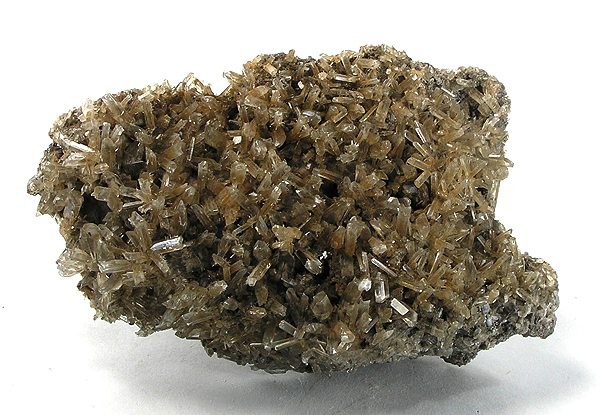
The University of Minnesota gypsum guide distinguishes clear crystals often called selenite, fibrous satin spar, massive alabaster and sand-bearing rose-like clusters. These names describe forms of gypsum rather than four unrelated minerals. Commercial labels are not always equally precise.
- Selenite
- Look for clear to translucent crystals, sometimes with broad flat faces. Existing thin edges may transmit light. Do not peel off a layer to investigate.
- Satin spar gypsum
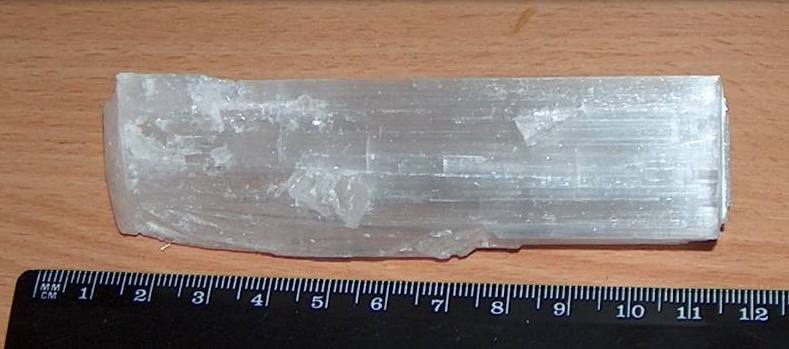
- Look for aligned, fine fibres and a silky directional sheen. Carving and polishing change the outline; a pointed tower is not proof of a natural crystal point.
- Gypsum alabaster
- A fine-grained massive material used for carving. The name “alabaster” can also be used commercially for other materials, so ask which mineral is being sold.
- Gypsum desert rose
- A cluster with petal-like forms and included sand. Similar-looking rose formations can involve other minerals; the shape alone is not a complete identification.

Properties that explain its care
Gypsum is hydrated calcium sulfate, CaSO₄·2H₂O. The MSA Handbook of Mineralogy lists hardness about 1.5–2, with a very easy cleavage direction and glassy, pearly or silky appearances depending on the form. A fragile edge can be damaged even when the rest of a large carving feels substantial.
Use the hardness information to choose storage, not as an invitation to scratch your purchase. An existing scratch is not an identification certificate: other soft materials can scratch too.
A safe observation sequence
- Set the object on a soft support. Before picking it up, check for loose fragments or fragile projecting crystals. Support the base rather than lifting by a tip.
- Look for fibres versus flat crystal faces. Use a magnifier on the existing surface. Do not sand, scrape or separate the fibres.
- Change the viewing angle. Move a room light or gently turn a stable object. Describe whether the sheen travels along parallel lines or you can see through a flat crystal. Neither observation is conclusive by itself.
- Record the commercial name. If a label only says “selenite charging plate,” ask whether the material is fibrous gypsum, another gypsum form or a different mineral.
- Leave uncertain material unidentified. A photograph can help a mineral club or gemologist decide the next non-destructive check, but it cannot reliably establish every white carving.
Materials that can be confused with gypsum
Clear quartz
A pointed transparent object might be quartz, gypsum or an imitation. Manufactured points make shape especially unreliable. Quartz is much harder, but do not perform a scratch contest on finished pieces. Compare unmodified features using the clear quartz profile.
Calcite and other pale minerals
Calcite can also be transparent or carved into pale decorative objects. Existing cleavage faces and internal features may help an experienced observer, but an acid test is destructive and unnecessary for a valued item. Request the mineral identity from the supplier.
Glass and manufactured white objects
A uniform color or a smooth shape is not enough to distinguish them. Seams, coatings and repeated patterns can provide questions to investigate, not a universal home authentication test. Avoid licking unknown samples or using flame, solvents or water exposure as tests.
Keep gypsum dry and protected
Gypsum is water-soluble to a limited degree. Repeated or prolonged wetting is therefore a poor care choice. Our conservative handling recommendation is dry cleaning only: gently lift loose dust from a sound surface with a soft, clean tool, without force. If it is flaky or powdery, stop and ask for specimen-care advice instead of brushing harder.
- Do not soak it, put it in a dishwasher or use steam or an ultrasonic cleaner.
- Avoid rubbing it against quartz, metal edges or a gritty cloth.
- Use individual padded spaces for travel. Do not pack a heavy stone on top of a thin plate.
- Keep it away from damp windowsills, bathrooms and direct heat. If accidentally wet, lift away excess moisture gently and allow it to dry without heating.
Read the focused selenite and water guide. For the common display question, see selenite with black tourmaline: placement and scratch prevention.
Does a selenite plate clean other crystals?
In crystal traditions, a plate may be used symbolically for “cleansing” or “charging.” That is different from removing dirt, germs or a coating. Putting a stone on gypsum does not establish a measurable energy change or replace appropriate cleaning. You can use a meaningful arrangement without letting the pieces scrape one another.
What should I ask a seller?
Ask for the mineral name as well as the trade name, a close-up of the fibres or crystal faces, whether a coating is present, and safe handling instructions for the actual object. For a carved item, also ask how it is supported and packed; a beautiful photograph tells you little about a fragile edge in transit.
Continue: crystal library · identification chart · pairing care principles.