
Identification & care guide
Agate or Geode? The Difference Explained
A specimen can be both an agate and a geode. Agate describes a banded silica material; geode describes a cavity-bearing formation with mineral growth inside. They answer different questions, so you do not always have to choose one label.
If a cut specimen has an agate rim around an open crystal-lined center, “agate geode” can describe both features. If you have only an unopened rounded rock, its outside may not reveal enough to decide.
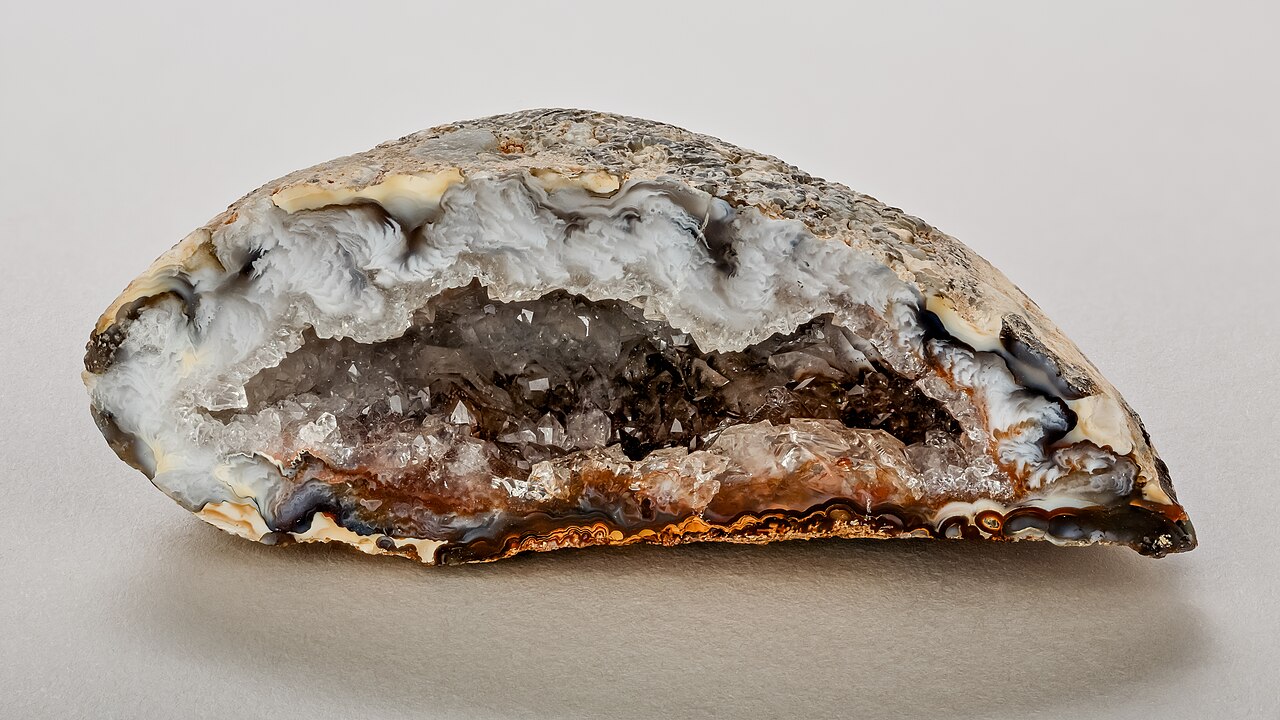
The simplest way to separate the terms
On small screens, swipe the table sideways to compare all columns.
| What you can observe | Useful description | What remains uncertain |
|---|---|---|
| Translucent bands in a polished or exposed section | Agate may be present | Exact variety, treatment, and locality |
| A natural hollow center with inward-growing crystals | Geode structure | The identity of each mineral |
| Banded rim plus a hollow crystalline center | Agate geode may fit | Whether all visible layers are correctly identified |
| A solid mineral-filled interior | Nodule is often the more useful structural term | The material still needs identification |
| Only a rounded weathered exterior | Unidentified rounded specimen | Whether it is hollow or contains agate |
This is a description guide, not a guarantee that every rounded stone belongs to one of these groups.
What agate describes
The British Geological Survey defines agate in terms of translucent, extremely fine-grained quartz and banded colors. That is a description of the material, rather than a promise that the object is hollow. BGS agate classification.
Start with a surface that is already exposed. Photograph the bands straight on and at an angle, including the edge of the specimen. A thin slice, a whole nodule, and a polished cabochon show different amounts of information. Do not assume that a dramatic photograph of one example represents every piece sold under the name.
What geode describes
In its account of Fort Payne geodes, the Kentucky Geological Survey distinguishes partly filled cavities from completely filled nodules and agate-filled examples. It describes crystal-lined interiors and explains that more than one mineral can occur. KGS explanation of geode formation.
The useful question is therefore not just “does it sparkle?” It is “am I looking at crystals growing into an internal cavity?” A coating of sparkling crystals on an external surface does not, by itself, establish that structure.
Can one stone be both?
Yes. Think of the labels as material plus structure. You might describe a specimen as having a banded agate outer zone and a hollow center lined with crystals. That sentence often communicates more than a forced one-word answer.
If the cavity is lined with a mineral you cannot identify, say so. “Agate-rimmed geode with unidentified crystals” is a more useful working description than confidently assigning a mineral from its color.
Conversely, a solid agate nodule does not need a hollow center to remain agate. The lack of a cavity changes the structural description, not automatically the identity of its banded material.
Do all geodes begin as volcanic bubbles?
No single origin story should be applied to every specimen. The KGS account linked above describes geode development in sedimentary rocks, including replacement and dissolution processes. It is a regional geological explanation, not a statement that every geode worldwide formed identically.
If you know where a specimen came from, preserve that information. A documented locality can help an experienced collector or geologist evaluate an explanation that cannot be established from the exterior alone.
A non-destructive first inspection
Place the specimen on a stable surface and photograph it beside a ruler. Record whether it is naturally broken, cut, polished, or still closed. Then note only what is visible:
- Are there bands, crystals, or both?
- Is an interior cavity actually exposed?
- Are you seeing the whole interior or only one small opening?
- Is there a reliable collection locality or an original seller label?
- Which parts of the description are observations, and which are guesses?
Avoid striking a specimen just to settle a naming question. Opening or cutting is destructive, can damage a display piece, and requires appropriate equipment and protection. A local lapidary club can help you decide whether further examination is worthwhile before anything is altered.
Buying an agate geode online
Ask for images showing the entire face and side, not just a close-up of the brightest area. Confirm whether the listing includes one half, a matching pair, or a representative piece. Ask separately about color treatment, repairs, and the identity of any decorative coating or added base.
Do not assume the term geode establishes rarity or value. Size, condition, appearance, documentation, and the exact item being offered still matter. A clearly described modest specimen is easier to assess than an impressive title with incomplete photographs.
The answer to keep
Use agate for the relevant material, geode for the cavity structure, and both when the visible evidence supports both. If the object remains closed, “not yet determined” is a legitimate result. Continue with our safe crystal identification guide to organize your observations without damaging the specimen.
Related identification guides
Types of Agate: Patterns, Inclusions, and Names · Types of Jasper: Colors, Patterns, and Trade Names · Crystal identification chart
Reference databases
Property and care guidance is checked against established mineralogical and gemological references. See our sources and methodology.